
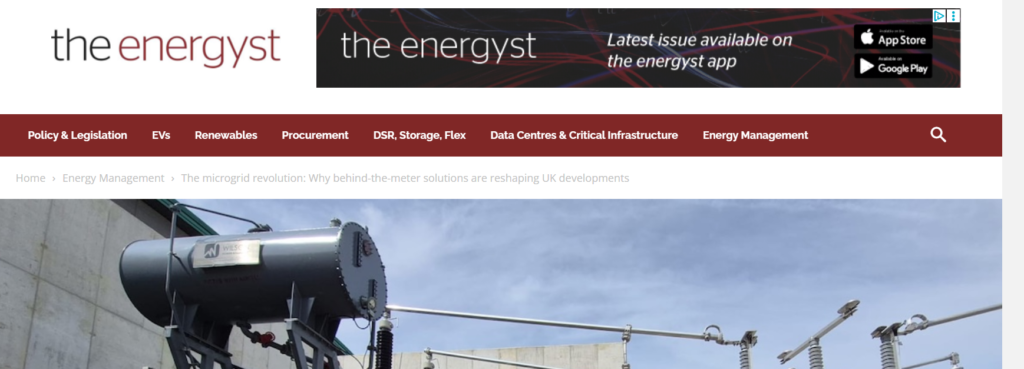
Many thanks to The Energyst for running Brian Loft’s thought leadership piece on the microgrid revolution. Full article below…
The microgrid revolution: Why behind-the-meter solutions are reshaping UK developments
In response to growing grid constraints and rising sustainability ambitions, developers are increasingly turning to microgrids to deliver more resilient, cost-effective and future-ready developments. Brian Loft, director of operations at Leep Utilities, looks at how this works.
The drivers for change
The UK’s electricity infrastructure is undergoing a quiet but profound transformation, as developers across the country start to implement microgrids on projects from housing estates to electric vehicle charging hubs. These localised electricity networks are usually a combination of solar generation and battery storage, and increasingly, intelligent energy management.
We’re seeing this shift accelerate month by month, driven by compelling economics and practical necessity.
Firstly, the retirement of older gas-powered combined heat and power (CHP) plants is removing a power generation option that many developments might have relied upon. Secondly, the electrification of heat is dramatically increasing power demands on sites, as heat pumps replace gas boilers. Thirdly, and perhaps most significantly, access to the national grid is severely constrained, with connection waiting times and capacity limitations forcing developers to look elsewhere for solutions.
The result is a rethinking of how we power new developments, with more developers looking to behind-the-meter solutions to reduce the cost of building their electricity networks. And it’s a trend that will continue to grow as more developers recognise how microgrids can enable them to increase the viability or value of a site.
The economics of microgrids
The financial case for microgrids has reached a tipping point. By generating and storing electricity on-site, developments can significantly reduce their reliance on the national grid. The potential cost savings of this approach are already recognised at a consumer level – solar panels generate power during the day, battery systems store excess capacity, and the stored power is used in preference to expensive grid power.
The principle remains the same for larger developments, but as the size of the development increases, so can the size and output of the microgrid. With the right planning, equipment and installation, microgrids make it possible to shrink the overall capacity of grid connection a development needs. This can reduce the overall cost of development, while also speeding up timescales currently affected by long grid connection wait times. This tactical use of microgrids can help developers meet increasingly stringent planning requirements, and achieve core business objectives around sustainability.
A good example of this is EV charging hubs, where we’re seeing solar and battery elements becoming standard rather than optional. The financial viability of these sites improves dramatically when they can generate their own power and avoid costly grid reinforcement charges. For housing developments, the economics work similarly – a microgrid reduces both the developer’s infrastructure costs, and residents’ ongoing energy bills. Later savings can be sizeable, particularly for developments with substantial common areas, EV charging infrastructure, or heat pumps.
New challenges require new thinking
Although a welcome transformation, the use of microgrids brings challenges that the industry must address. Perhaps the most critical is safety. Utility companies have traditionally assumed that a site disconnected from mains supply is safe to work on. That assumption no longer holds. With battery storage and solar panels potentially continuing to generate and store power even when grid supply is isolated, work practices must evolve.
At Leep, we’re updating our safety protocols to account for this new reality. Every site now requires a thorough assessment of behind-the-meter generation before work begins – our teams are being trained to identify and safely isolate all potential power sources, not just the grid connection. It’s a significant shift in operations that needs to be adopted across the entire utilities sector.
Monitoring presents another challenge. Networks need enhanced capabilities to track behind-the-meter generation, understand load patterns, and maintain system reliability. The traditional model of centralised grid management is giving way to a more distributed approach, where intelligence sits at the edge of the network as well as the centre.
The impact on developers
For developers, the message is clear: microgrid solutions should be considered from the earliest stages of project planning, not retrofitted as an afterthought. The optimal configuration of solar capacity, battery storage and grid connection will depend heavily on the site’s specific characteristics – the mix of residential and commercial space, the presence of EV charging, the building orientation, and local planning requirements.
For residents in these developments, the implications of microgrids are largely positive. Energy costs should be lower than in traditional developments, which is of great value in a time when electricity prices remain volatile. The infrastructure is typically managed by the IDNO or residents’ management company, making it largely invisible to individual households. However, homeowners should understand that their energy system is more sophisticated than a simple grid connection. Maintenance requirements differ, and the presence of solar panels and batteries may affect ongoing maintenance and service charges. Transparency from developers about how these systems work and who maintains them will be crucial.
All this is true for more than residential projects – microgrids can also deliver significant benefits to commercial projects ranging from charging hubs, small commercial sites, or even an eHGV depot. In short, behind-the-meter solutions can often make viable a site that would otherwise face prohibitive grid connection costs or impossibly long waiting times. They can also help satisfy planning conditions around sustainability and carbon reduction. As grid constraints worsen, we expect these solutions to transition from a competitive advantage to basic necessity for many developments.
Looking ahead
The microgrid trend reflects a broader shift toward decentralisation in energy systems. As renewable generation becomes cheaper, battery technology improves, and grid constraints persist, the logic of generating and storing power close to where it’s consumed becomes clear. We’re moving towards a hybrid model where local generation and storage work in partnership with the wider network.
For the utilities sector, this requires adaptation. Our infrastructure designs, work practices, monitoring systems and commercial models all need to evolve. At Leep Utilities, we’re embracing this change, working with developers to design and implement microgrid solutions that deliver reliability, sustainability and value.
www.leeputilities.co.uk/developers
Link to the article here: The microgrid revolution: Why behind-the-meter solutions are reshaping UK developments – theenergyst.com