
When people watch a race, they see the finish line. They see the medals, the celebrations and the final result. What they don’t see is everything that happens in the minutes, hours and months beforehand.
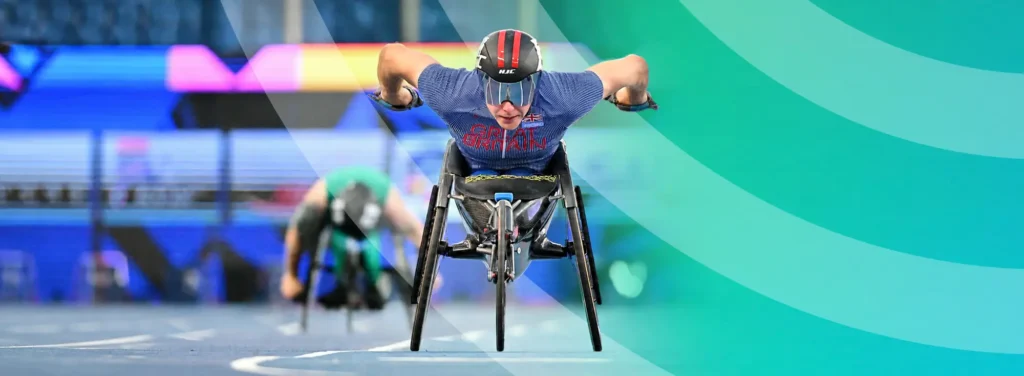
My recent visit to Glasgow to defend my T54 1500m Commonwealth title was a reminder that elite sport is rarely straightforward. Out of the whole field there were 4, including myself, that stood out as medal contenders. Only three medals were available. That sounds obvious, but it completely changes the psychology of the event.
As the reigning Commonwealth champion, I knew I wasn’t just another competitor. I was the athlete everyone wanted to beat.
The Australians arrived with a clear strategy and executed their team tactics brilliantly in their pursuit of gold. Meanwhile, the tactics of the other Team England athlete confirmed something I’d already suspected: I had a target on my back.
And that’s absolutely fine. Because once you’re out on the track, it’s still an individual sport. The real battle, though, often starts long before the race itself.
About 30 minutes before competing, athletes are taken into the Call Room, where we’re held until it’s time to enter the arena. It’s a strange environment. There’s very little to do other than try to keep your mind occupied with some light stretching and a few exercise bands. The anticipation builds. The nerves build. And this time, they built to the point where I was physically sick.
In hindsight, maybe that worked in my favour. Perhaps the other competitors looked across and thought I was having a bad day. I certainly wasn’t going to correct them.
Once the race started, I knew exactly where I needed to be. In wheelchair racing, position is everything. Each racing chair is around two metres long. If you find yourself in fifth place, you’re already 10 metres behind the leader, and that’s simply too much ground to recover against world-class athletes. I knew I had to stay in the front half of the field.
With one lap remaining, I genuinely thought I was racing for bronze. But experience teaches you something incredibly valuable: trust the process. Trust your preparation. Trust your strengths.
I knew my finishing kick was my greatest weapon, but I also knew I had to be patient. At one point, I felt like a wasp repeatedly bashing against a window, searching for a way through.
Then it happened. The gap opened. I attacked it. I accelerated. And suddenly, I wasn’t chasing bronze anymore.
I crossed the line to defend my Commonwealth title and win gold, with my family cheering me on from the stands. That made this victory even more special.
For the first time at a major championship, I wasn’t just competing as an athlete. I was competing as a father. Normally, my wife would be competing alongside me, but this time she was in the stands with our daughter, Rosie.
Being away from them wasn’t easy. But there was one unexpected benefit. For the first time in my career, I was able to have a mini, distraction-free training camp before the competition. Was that the difference between bronze and gold? Honestly, who knows?
Elite sport is full of tiny details, and that’s why athletes become obsessed with marginal gains.
Glasgow itself was another interesting experience. The Games were delivered in just 18 months, compared with the seven years that host cities would normally have to prepare. I think everyone was curious about how that would work. The reality was that it was still an outstanding sporting environment.
The accommodation was excellent, transport was seamless and, after training in 30-degree temperatures, competing in 16 degrees felt positively comfortable.
There was no traditional athletes’ village this time. Instead, each sport had its own dedicated hotel. That meant disciplines didn’t mix in the same way, but athletes from different countries still shared the experience.
And now? There’s no time to stand still. Next up is a triple-header in the Swiss Diamond League at the end of August before my focus shifts towards road racing.
But if there’s one thing elite sport teaches you, it’s that success has an incredibly short shelf life. The World Championships are still 10 months away, but preparation has already started. My competitors around the world won’t be taking it easy. They’ll be training harder. They’ll be searching for innovations. They’ll be chasing every possible marginal gain. And that’s exactly what I’ll be doing, too.
Because the pursuit of excellence is relentless.
One race at a time.